December 31, 2022
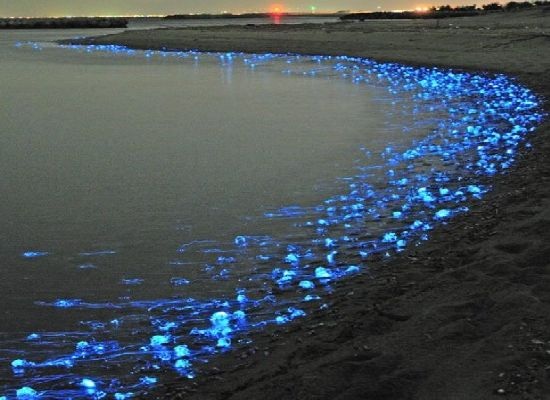
Do you know which Japanese city has bioluminescent squid that turn shore waters neon blue, mountain passes with 65-foot walls of snow, and a plan for sustainability into the future?
.
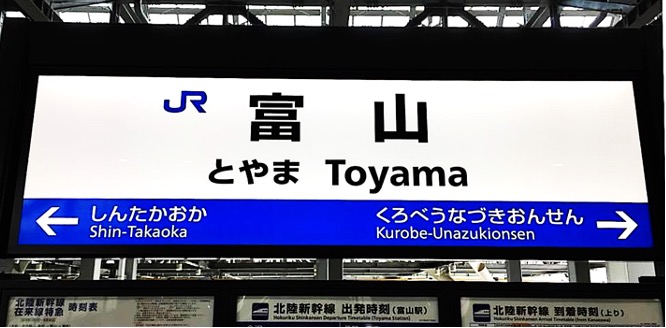
Japan Railways sign at Toyama Station
Source: © LLJLoveLearnJapan, 2018
If you guessed Toyama, you are right!
The city of Toyama sits between the northern Japanese Alps 日本アルプス and Toyama Bay on the Sea of Japan 日本海. Although the Japanese characters for Toyama, 富山, mean “abundant mountains,” the water’s importance to the city cannot be overlooked.
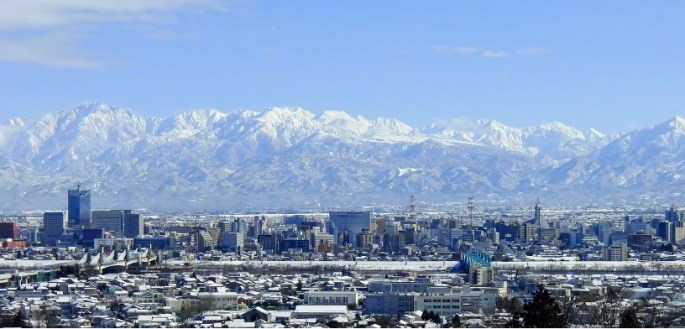
Cityscape of Toyama and Tateyama Mountains
Source: Wikimedia Commons, 2016, attribution to タチヤマカムイ
You may be thinking: that’s cool and all, but what’s the big deal?! Most of Japan’s communities are tucked between sea and mountain. After all, this volcanic archipelago is all long coastlines and narrow islands—the widest part stretches less than 200 miles across—with mountains covering 80% of the terrain. Even so, Toyama (which also serves as the capital of Toyama Prefecture) is uniquely situated and is fighting to stay vital and environmentally sustainable through its efforts to become a compact city.
Part I of this post looks more closely at Toyama’s natural setting and Part II explains the implementation of the “compact city” vision to provide a clearer sense of Toyama’s distinct identity.
In Toyama, the mountains and the water have a close environmental relationship that accounts for both its dramatic snowfalls and its abundant sea life. Toyama’s mountains rise over 3000 meters (almost 10,000 feet) in the air and its bay dives another third as much at its deepest point, creating a steep drop to the seafloor. Local fishers call the indigo waters of the Toyama Trough’s canyons aigame 藍瓶. Aigame is the name for pots that store indigo dye, providing an effective visual for these fishing grounds.
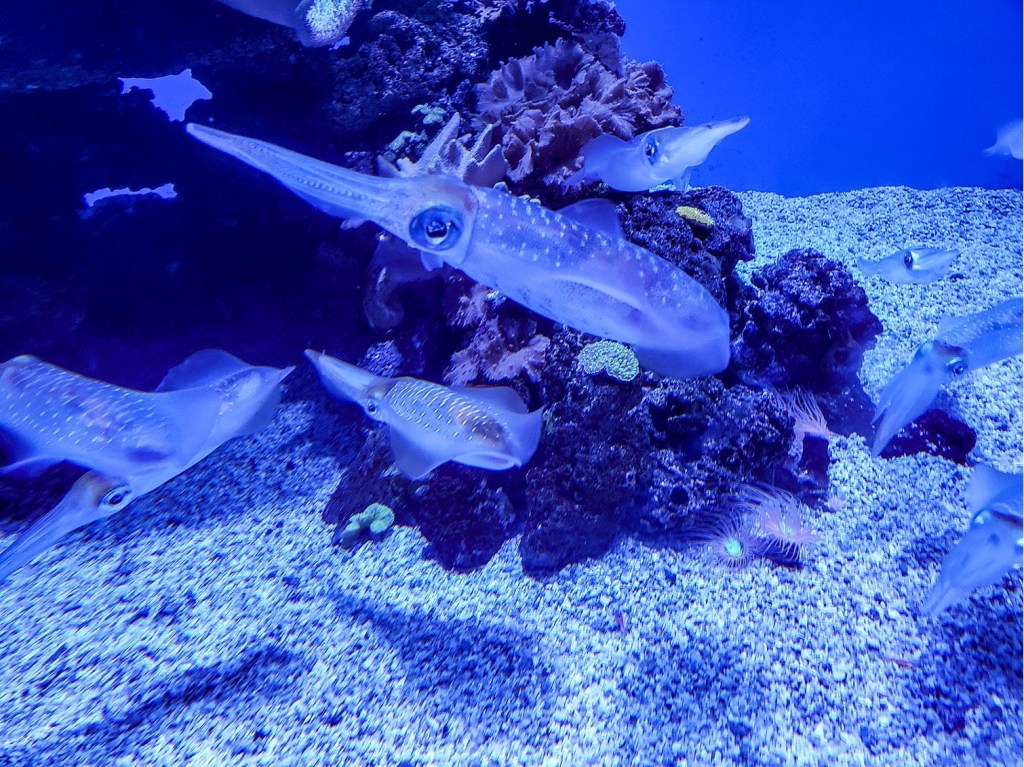
This picture of firefly squid gives you a sense of indigo waters. Source: Wikimedia Commons, 2019, attribution to Circe Denyer.
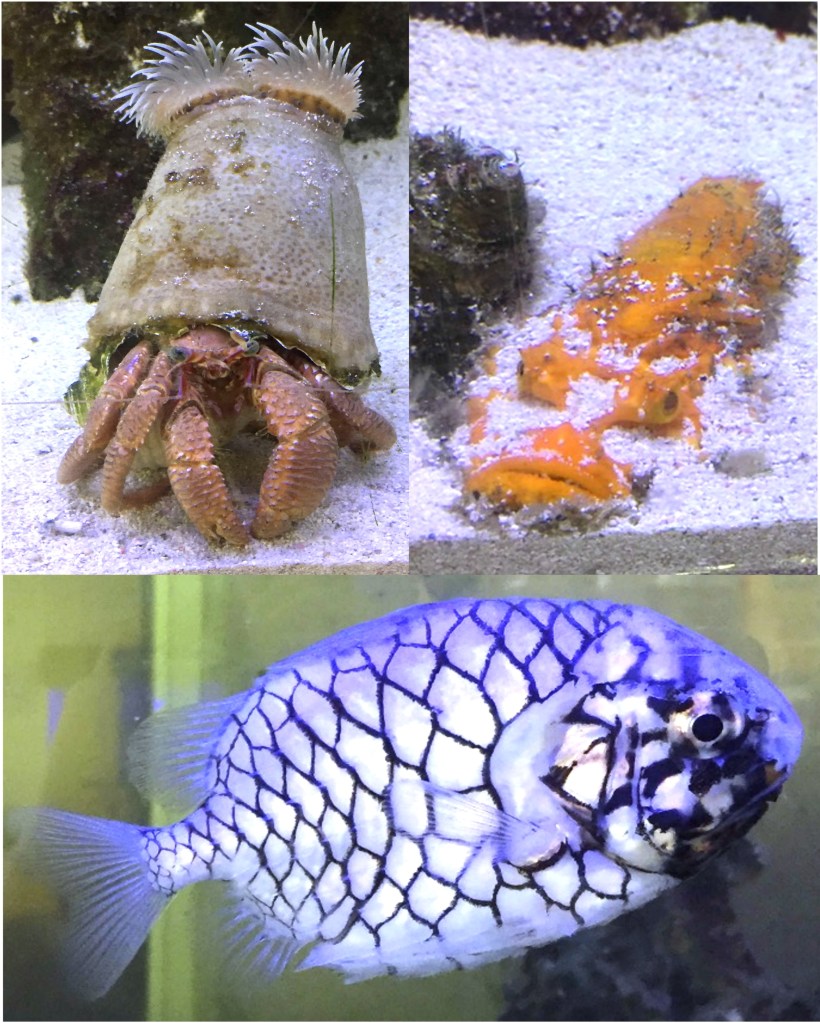
Right: These marvelous creatures were at a roadside tourist stop that had an aquarium displaying sealife from Toyama Bay. Source: © LLJLoveLearnJapan, 2018.
In Japanese, the character for water is 水 (the onyomi sound reading is sui スイand its kunyomi Japanese reading is mizu みず). See my post explaining these readings here. Do you think 水 looks like water? As a radical, used on the left, its form evokes a splash of water: 氵. As you probably guessed, the water radical appears in the kanji character for sea or ocean (海 (カイ;うみ)), as in the Sea of Japan (Nihonkai 日本海), and in the character for bay 湾 (ワン: いりえ), as in Toyama Bay, Toyama-wan 富山湾. The images below provides the oracle bone version (Chinese writing from as early as 2000 BCE) of water.

Here you can scroll down to find the character’s evolution along with with an animated stroke order showing you how to write this 4-stroke character, which is also a radical in its own right.

Similarly, the kanji for mountain 山 (サン; やま) is suggestive of a mountain, don’t you think? In this case as well, the character (click here for evolution and stroke order) is also the radical.
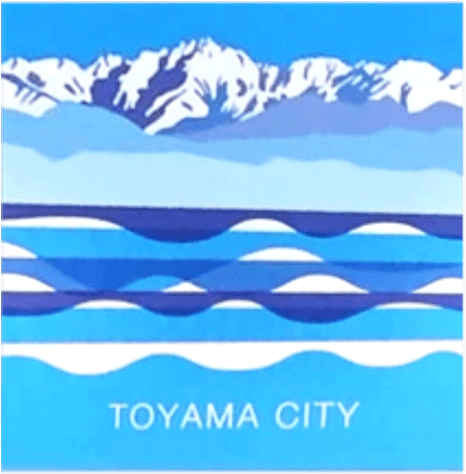
Above left: I took a photo of this banner hanging in the Toyama train station. It clearly reflects the city’s deep connection with both the water and the snow-capped peaks that tower over urban life. In fact, the city cannot be seen nestled between them and is only represented by the title but the Toyama Prefecture Tourism website uses “sea and mountain,” or umitoyamato 海と山と, as a catchphrase that pairs the two with the double use of the particle “to” (pronounced “toe”).
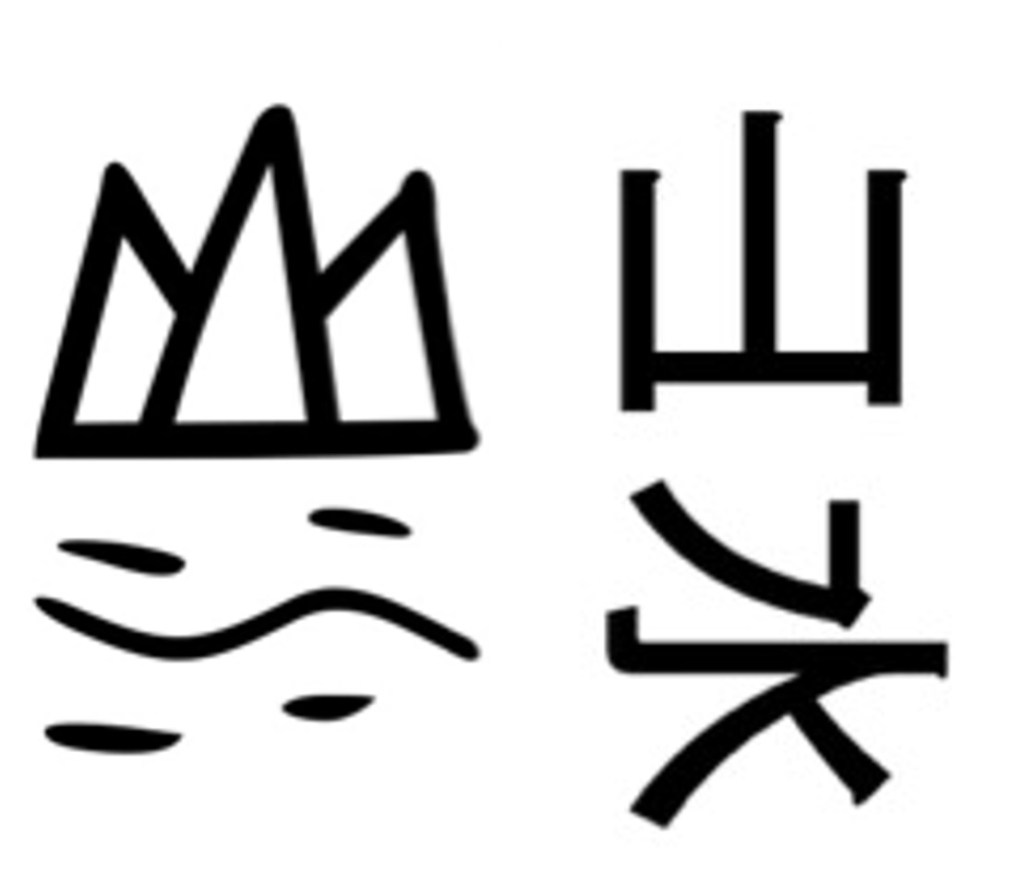
Center: Just for fun, I put the oracle bone pictograms alongside the contemporary kanji but with water sideways (don’t do this at home) and mountain on top—to mirror the banner. Which do you like better? The pictograms create a stronger pictorial likeness but you still get the sense of it with the kanji. How can you not absolutely love this writing system?! Alphabet schmalphabet.
During the spring and summer, Toyama Bay is warmed by the northeasterly-flowing Tsushima Current that branches off the North Pacific’s vital Kuroshio Current. In winter, when cold Siberian air sweeps down from the northwest, it picks up moisture from the comparatively warm water to generate significant amounts of heavy snow along the Japanese Alps, a region known as snow country, or yukiguni 雪国.
For Toyama, the snow-capped mountains are not merely a stunning backdrop to the city; they are a cultural icon, a playground, as well as a vital source of fresh water, hydroelectric power, and tourist revenue. The tallest peaks are on Mount Tate (Tateyama 立山), one of Japan’s three “holy mountains” (along with Mt. Fuji and Mt. Haku). Toyama–a major stop on the bullet train (shinkansen 新幹線) from Tokyo–serves as the gateway to downhill and backcountry skiing, mountain treks, autumn leaf viewing, and noted sights, including the power-generating Kurobe Dam, which is considered an engineering feat of the postwar era.
In April, the Tateyama Kurobe Alpine Route opens to allow for scenic travel through this restricted area via a carefully-crafted system of transportation using rail, buses, cable cars, and a ropeway. As one of the snowiest places in the world, the route is impassable in winter and barely accessible in the spring. This is where the snow walls come in! Snowplows dig down to the paved roads so that buses can drive through the winter’s extraordinary accumulation. The buses use green energy, in part, to prevent contaminating the walls with the fuel particles that would blacken the snow and pollute the runoff.
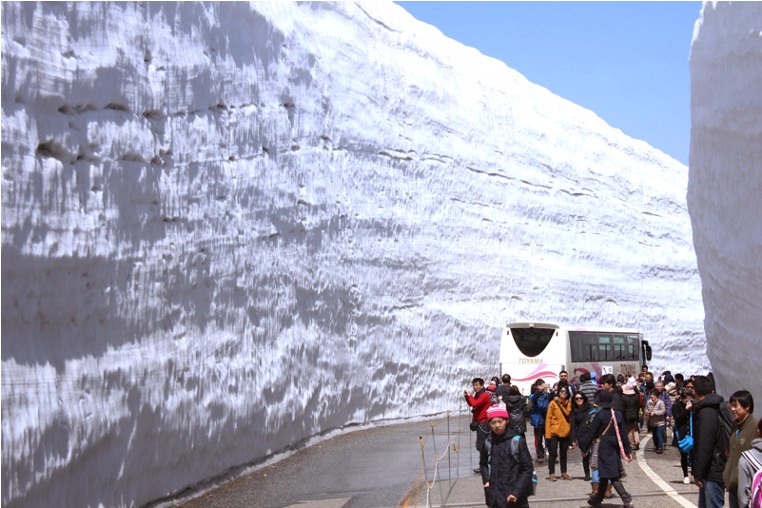
Snow Wall from Tateyama Kurobe Alpine Route
Source: Wikimedia Commons, May 2015, attribution to タチヤマカムイ
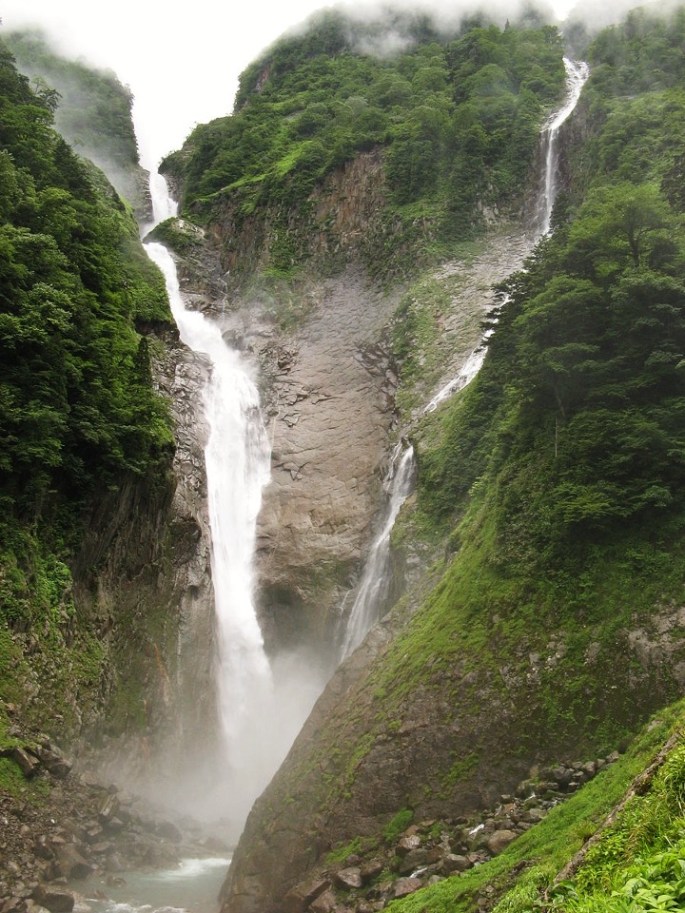
Shōmyō Falls (left) and Hannoki Falls (right).
Source: Wikimedia Commons, July 2016, attribution to kahusi (會話).
As the snow melts through the summer, it feeds two of the country’s tallest waterfalls, Shōmyō Falls (称名滝) at left and Hannoki Falls (ハンノキ滝) to the right. Did you notice the water radical on the character for waterfall, 滝 taki? The freshwater melt also runs down the mountain’s rivers and into Toyama Bay. The bay receives this freshwater from above but fresh ground water also rises up through the seafloor. These sources of freshwater create variable salinity, which together with its differing depths and temperatures, allows for a great diversity of sealife.
Here’s where the glowing squid come in!
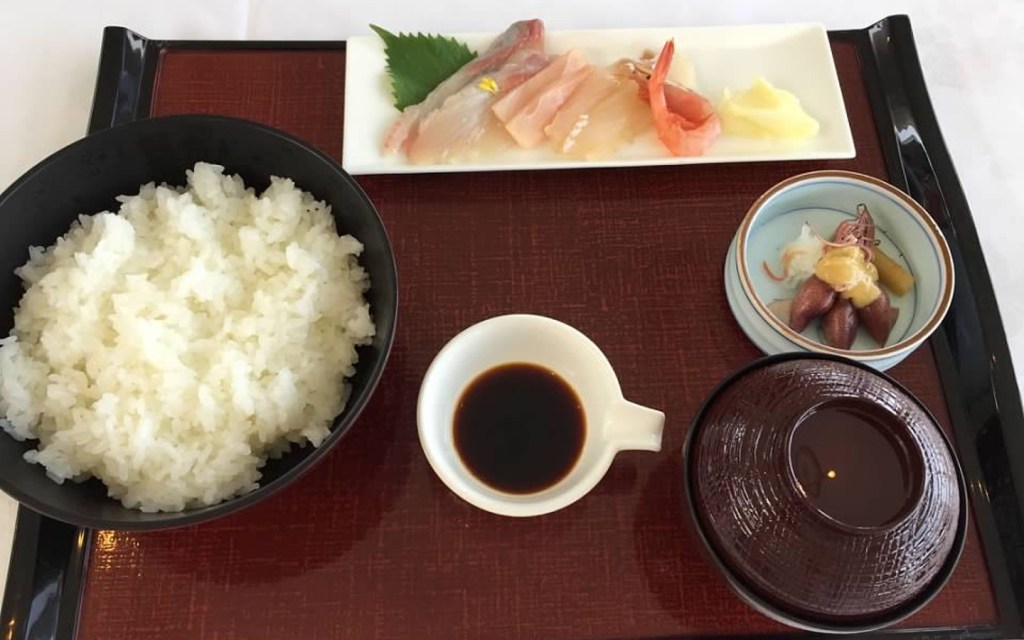
The author took this photo at the Hotaruika Museum‘s panoramic restaurant where they serve sweet glass shrimp and boiled firefly squid.
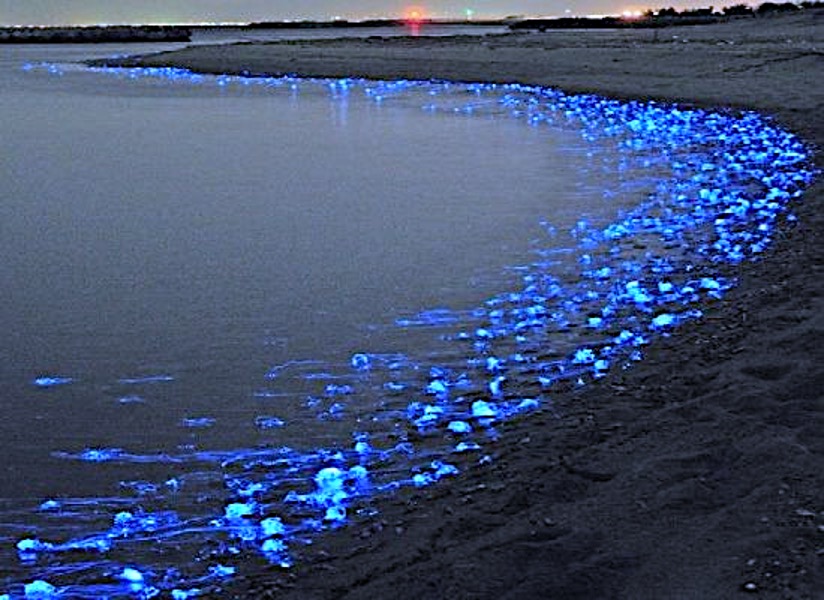
Photo of firefly squid washing ashore
Source: Eat Up Japan
The firefly squid only come up from the bay’s depths in the spring to spawn. Check out this National Geographic video (3 minutes) of these amazing creatures! Beyond the creatures in the photos above, the bay is famous for occasional sightings of giant squid and local delicacies like glass shrimp and firefly squid.
The Japanese word for these Toyama glass shrimp is 白海老 shiroebi or 白 white + 海老 shrimp, or prawn. I love the word for shrimp because it combines the characters for sea and old age/old man. The etymology of the word “ebi” is said to come from a once-used word for grapes due to perceived similarities in color. The characters used to match the sound suggest these creatures are the “old man of the sea,” a reference to their curved backs and whisker-like antennae.
Since the bay’s seafood catches can be brought quickly into port, it is served very fresh. The word kitokito (written in katakana as キトキト ) comes from the regional dialect and is an onomatopoeia used to describe freshness. It has even become a promotional nickname for the airport–Toyama Kitokito Airport.
Up next is Part II of this post, where you can learn about Toyama’s efforts to become a compact city. It also, in part, discusses how Toyama is responding to Japan’s graying population.
Movie Recommendation: The award-winning 2015 Japanese documentary by Shigeru Kobayashi, Dryads in a Snow Valley (風の波紋, Kaze no hamon) is free for public viewing through the Japan Foundation until March 15, 2023. It is a wonderful meditation on village life in the Japanese Alps. You can see the incredible amounts of snow and how the people living there thatch and clear snow from the roofs of their homes. The film also shows things like rice farming and traditional handicrafts. The film further considers Japan’s changing demographics and what population loss means for regions that are already struggling.
Book Recommendation: The nobel-prize-winning novel Snow Country (雪国, Yukiguni) is set in the forbidding winter terrain of the Japanese Alps. It was written by Yasunari Kawabata in the 1930s in serial form and translated into English in 1956. Although it is readily available and widely read, like a lot of classic literature, it is not easy but worth the effort.
では またね!Thanks for reading!
 love・learn・Japan