

The artful manhole covers マンホールの蓋 that dot streets in Japan bring color, history, and cultural charm to what is otherwise a drab necessity of modern life.
To beautify the lids covering points of access to the essential but unpleasant underbelly of cities and towns is a stroke of genius. Although Japan is not alone in having decorative covers for sewer and water systems, the country’s devotion to this type of street art is exceptional. Thousands of designs are spread across all 47 prefectures from Okinawa in the south to Hokkaido in the north, but they are concentrated in the urban centers of Kantō 関東 and Kansai 関西. Japan’s unparalleled public transportation system means walking is part of daily city life so artful manhole covers enhance the urban landscape. For most people, these pieces of art offer splashes of color and fun to gray streets but, for some, they have become an obsession.
Where do you stand? Are you apathetic? Appreciative? Or have you veered toward the obsessive side? Here’s a ten-point quiz to help you find out.
- Do you collect manhole cover trading cards? (see more cards here)
- Do you wear t-shirts sporting covers you like?
- Do you travel the country in pursuit of a coveted find?
- Do you provide coordinates to finder websites?
- Do you make pencil rubbings (拓本 takuhon) of your favorite covers?
- Do you spend your ¥100 coins on Gashapon capsules hoping to get that one plastic cover?
- Have you ever eaten pancakes or dorayaki (どら焼き) branded with cover designs?
- Do you sew quilts with manhole cover designs on them?
- Are you a member of the Japanese Society of Manhole Covers (日本マンホール蓋学会) and attend annual summits? (Even though this linked site is in Japanese, you can click the dated links to see the newest additions they’ve cataloged.)
- Do you believe that the covers (aka Poke lids) mark holes originally created by the Pokemon Diglett?
If you don’t know what these questions even mean, read on to learn about this street art. If you can say yes to a few of these questions, then you have been indoctrinated but may not yet be in trouble. If you can say yes to most or all of these questions, then you are likely a true #drainspotter or #manholer.
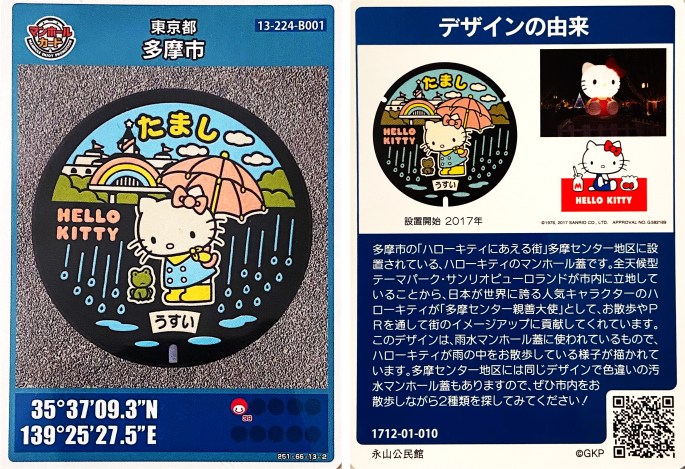
This image shows the two sides of a Hello Kitty manhole cover trading card from the city of Tama 多摩市 in western Tokyo Prefecture 東京都. 市 means city and 都 means capital or metropolis and is the only one of Japan’s 47 prefectures that uses this designation. Most use -ken, but the 4 in use are encapsulated by the word Todōfuken 都道府県.
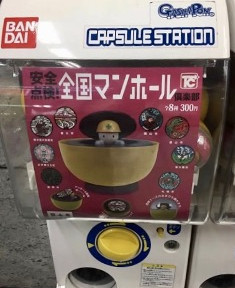
Personally, I have not quite reached the level of obsession but have moved well beyond apathy. For me, it started with randomly purchasing a Gashapon outside Akihabara Station. Less enticed by the covers themselves than by the little yellow-hatted head of the construction worker peering out, I put three 100-yen coins in the machine. There were 8 possible covers. I ended up with rugby players.
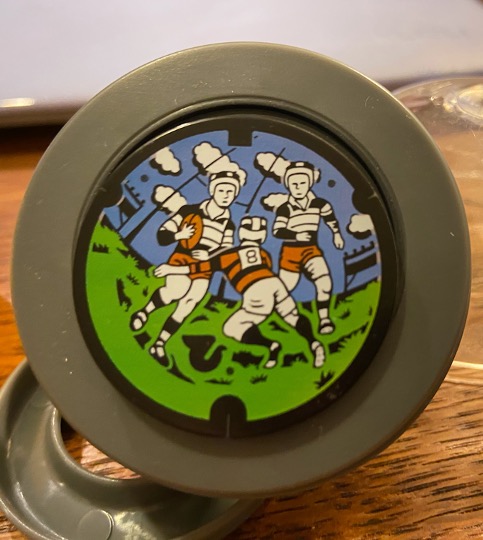

To be honest, this was not the cover I was hoping to get. I’d have preferred the Sapporo salmon and clock tower combo, Fukuoka’s abstract design of buildings, birds, and a yacht, Otawara’s 12th-century samurai Nasu no Yoichi, or really any of the others. But the rugby players did have one thing going for them—Osaka!
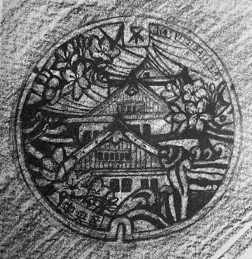
Speaking of Osaka, here’s a drawing I did of a cover featuring Osaka Castle (大阪城 or Osaka-jō), made to look like it’s a rubbing of a real cover. This link to the Society of Manhole Covers takes you directly to images of the real cover in full color.
Ōsaka 大阪 is part of Kansai 関西, which is the western portion of Japan’s main island of Honshū 本州. Kantō 関東 is the eastern half and its main city is Tōkyō 東京. 西 is the kanji for west. Its onyomi is sai さい, as in Kansai, and its kunyomi is nishi にし, the word for west. 東 is for east, or higashi (my first post introduces onyomi and kunyomi readings of kanji 漢字). The onyomi reading for 東 is tō とう, and is also the first character in the word for Eastern Capital, or Tōkyō. The two regions of Japan have a strong rivalry that is based on historical differences, including linguistics ones that can be heard in their different dialects—Kansai ben 関西弁 and Kantō ben 関東弁.
Since I lived in Osaka for three years, getting rugby players (who actually represent Higashi Osaka) made me good with it. Plus, I did get the little construction worker (or at least the semblance of him since he’s really just a head and arms without a body).
It may seem odd that such a thing as manhole covers, マンホールの蓋 (ふた), would be pocket-sized toys, but it is perhaps a logical outcome of the intersection between city-branding and collectible merchandise. But as the quiz questions above make clear, the covers have become a serious phenomenon. So how did they get that way??
Although it’s tempting to only identify these artful covers as urban art, doing so would be misleading since their origin lies in a rural campaign. When the Meiji (1868-1912) government launched Japan’s modern sewer system in 1884, it was only put in the biggest cities with the goal of draining rainwater. A handful of cities would eventually get water treatment facilities but domestic rebuilding and the rise of Japan’s economy in the decades after World War II led to significant pollution problems and necessitated the implementation of modern sewage systems nationwide. Almost exactly one hundred years after the original launch, in 1985, a civil servant named Yasutake Kameda conceived of the idea to beautify the manhole covers in an effort to convince reluctant rural populations that the high costs would be worth it. There’s no way he could have imagined his inspired idea would develop into a global obsession!
The newest twist on manhole covers is embedding them with LED lights, raising the bar for the next generation of gatcha replicas. I can’t wait to see the lighted covers on my next trip! What cover innovation do you think will be next??
では またね!Thanks for reading!
 love・learn・Japan