
Last updated August 7, 2022
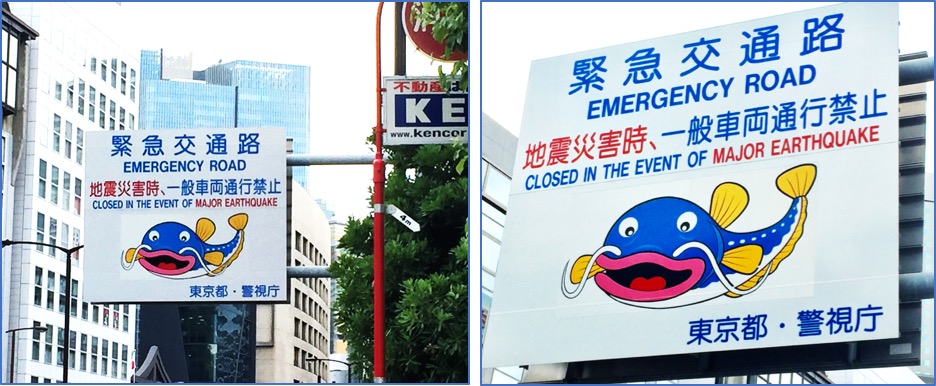
One thing that really caught my attention on my most recent trip to Tokyo was a sign hanging over Sotobori Avenue (Sotobori-dōri; 外堀通り) with an image of a giant catfish, or namazu 鯰, on it. Why would a street sign feature a catfish, especially when its aim is to inform the public that the road will be closed in the event of a major earthquake?? It seems an unlikely pairing—a catfish and an earthquake—but it makes eminent sense in Japanese cultural history. The catfish has been associated with earthquakes in Japan for centuries.
Long before seismologists entered the picture, folktales were used to explain natural phenomena like earthquakes. One legend was that a large creature—like a dragon or a giant fish—lived under the Japanese islands to keep them afloat. When the creature moved, it could trigger earthquakes. In the fourteenth century, “catfish” maps were said to be able to predict earthquakes. Over time, the idea that catfish generated earthquakes prevailed in the popular imagination.
During the mid-nineteenth century, three major earthquakes occasioned the production of hundreds of catfish pictures, or namazu-e 鯰絵, which appeared, for example, in mass-produced broadsheets (kawaraban 瓦版, “tile block prints”). Beyond offering a sense of causality and thus the possiblity of controlling earthquakes, some namazu-e also conveyed the idea that destruction could lead to “world renewal” or yonaoshi 世直し. Catfish are thus associated with the concept of yonaoshi, which really deserves a post all its own.
In English: Emergency Road; Closed in the Event of Major Earthquake; Tokyo
In Japanese: 緊急交通路;地震災害時、一般車両通行禁止;東京部・警察庁
地震 = じしん (jishin earthquake) + 災害さいがい (saigai disaster, calamity)
禁止 Kinshi is one of the most common words you’ll find on signs throughout the country. The character 禁 kin means prohibition or ban. Used with 止 shi (or 止まる tomaru—meaning to stop or cease), the word means that something is prohibited. More simply, it means don’t do it. You will see kin or kinshi combined with the kanji (characters) for the actions you are not to perform.
進入禁止 (しんにゅうきんし) means “do not enter” or “wrong way”;
ゴミ捨て禁止 (ゴミすてきんし) and
ポイ捨て禁止 (ポイすてきんし) both mean “no littering”;
駐車禁止 (ちゅうしゃきんし) means “no parking”
One that I have found very useful is 禁煙 kinen, which means “no smoking.” At a restaurant, for example, you can ask for a 禁煙席 kinen seki, or a non-smoking seat). This hasn’t always been the case. Even through the 1990s, people could smoke pretty much anywhere in public, including on trains (although non-smoking cars did exist) but smoking culture, public tolerance, and laws have been slowly changing in favor of smoke-free public spaces.
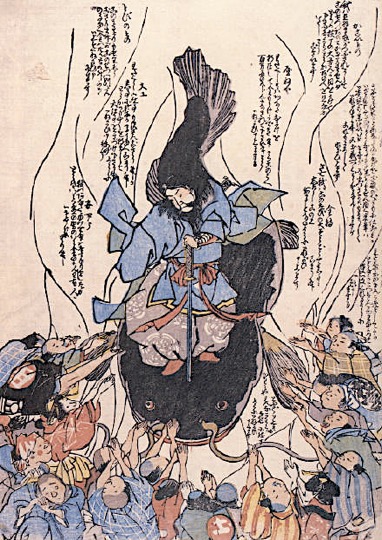
鯰を押える鹿島大明神 なまずをおさえるかしまだいみょうじん
The Deity Kashima Subdues the Catfish
Kashima, the god of thunder and blades, is the deity responsible for subduing Namazu. Here he is using a sword, though he might also use a special “keystone,” to hold down the catfish and prevent it from thrashing and causing an earthquake.
The keystone, or Kaname-ishi, is housed at Kashima Shrine in Ibaraki Prefecture. There is a collection of some namazu-e available at the International Research Center for Japanese Studies.
Although people no longer think catfish cause earthquakes, there are questions about whether they can predict them. In observable behavior, catfish are said to become agitated when they sense subtle vibrations as the earth begins to shift. They may start to act bothered even several days before an earthquake occurs. Japanese scientists have studied and documented the correlation, but the data isn’t strong enough to suggest humans can rely on catfish to predict the next big one.
Sitting on the ominously named Ring of Fire, tremors are a regular occurrence in Japan.
Earthquakes come first in the Japanese traditional expression of the things one fears in life: “earthquake, thunder, fire, father” 地震雷火事親父 jishin, kaminari, kaji, oyaji), although the last one holds less power than it once did.
As you can tell from the discussion of kin 禁 above, each character has a specific meaning. So the word for earthquake is made up of the character for earth 地 and the one for 震 quake or shake. But clues to meaning, pronunciation, and classification are also embedded in each character through key elements, called radicals. All kanji either contain a radical or are themselves radicals. In the case of 地, the left part — 土 (つち or tsuchi) — by itself means earth or land. In the case of namazu 鯰 , or catfish, the left part — 魚 (さかな or sakana) — means fish.
Earthquakes are as frightening as ever and you may well feel slight shaking from time to time in Japan. In fact, two medium-sized temblors shook Japan simultaneously just last week. You can track daily seismic activity through the Japan Meteorological Agency.
Most of this seismicity is relatively minor. You are likely more familiar with the massive quakes Japan has suffered over the past century, such as the 1923 Tokyo Earthquake (you can see footage of it), the 1995 Kobe Earthquake, and the more recent, catastrophic March 11, 2011 Tōhoku 東北 earthquake, often referred to simply as 3.11. This magnitude-9.0 quake generated a massive tsunami 津波 that in turn caused the systems failure and core meltdown of nuclear reactors in Fukushima.
Since that devastating triple disaster, predictions for the next big quake have intensified. Scientists have deemed eastern Hokkaido, Shizuoka Prefecture, and Tokyo to be at the highest risk. A large earthquake in Tokyo is of particular concern. Combined with neighboring areas, including Yokohama, the Greater Tokyo Area (or Tokyo daitoshiken 東京大都市圏) is the world’s most populous high-density megalopolis with upwards of 40 million inhabitants. The Tokyo Metropolitan Government has created and distributed an earthquake manual with a manga 漫画 called Tokyo “X” Day to help educate residents about the threat and how to respond to an event they see as an eventuality. The possibility of a Tokyo earthquake in the near future is something that the 2020 Olympics Committee is also taking seriously since the games will bring in millions of people and the country also has a large stake in their success.
Pokemon aficionados might feel safer having a Bayleef or Meganium nearby to counter the attacks of Whiscash or, in Japanese, Namazun ナマズン. Whiscash is a water, ground Pokemon derived from the mythology of the catfish Namazu. Whiscash causes earthquakes and can also predict when natural earthquakes will occur. Bayleef and Maganium are grass Pokemon capable of defeating Whiscash.
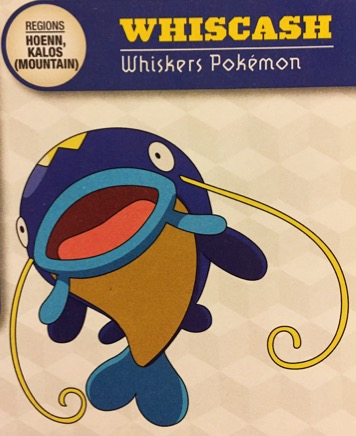
Does this image look similar to the namazu catfish on the street sign??
Although Japan has some of the best seismic technology and disaster planning in the world—skyscrapers that can sway to withstand vibration, special levees, and disaster prevention parks and routes marked with catfish like the sign at the top—I’m still rooting for the catfish to help us all out.
では またね!Thanks for reading!
 love・learn・Japan
Can’t wait for the next post!
LikeLike