
Last updated July 22, 2022
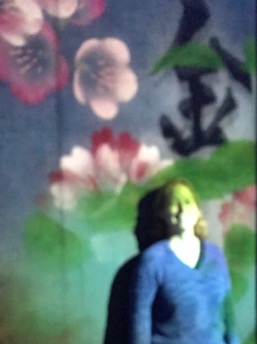
This summer (2019) I visited the new teamLab Borderless digital art museum in Odaiba (Tokyo). It is AMAZING!! You have to go if you get the chance (it will be relocating after August 31, 2022). The astonishing beauty of this digital art, its vivid colors, and its immersive design made this a unique and unforgettable experience! The lanterns photo on my homepage is also from an exhibit. It turns out that we were 4 of 2,198,284 visitors in 2019, helping it receive the Guinness Book of World Records award for most visited museum for a single artist or group in the world.
I personally loved the images of flowers and kanji 漢字 (see below) that glided across the walls of the gallery. My husband, after many tries, snapped this photo of me before the kanji suddenly sped up and zipped away before another slowly came near my head. Its presence, too, was ephemeral. The beauty and sorrow of impermanence is a theme that runs through Japanese culture and is known as 物の哀れ, mono no aware, or the “pathos of things.”
漢字 = KANJI, OR CHINESE CHARACTERS
漢 “China” (more specifically, Han China) + 字 character or letter
These indicate that this writing system came from China (by the 5th century) and became a key component of written Japanese (see my post on Kinkakuji temple to learn more about Japan’s 3 writing systems).
Standing in the gallery as kanji drifted past—but did not stay—while my husband patiently waited to get a photo, feels like the perfect metaphor for how elusive it is to maintain some fluency when you aren’t living in Japan. When you are using Japanese all day, every day, the kanji are right there, hovering, ready to be captured whenever you want. Now that it has been more than fifteen years since I last lived in Japan, I’ve found that many of the kanji that reside in my head are unpredictable. Some seem to be coming into focus but remain just out of reach, and then—zip—they are gone! Beautiful characters, frustratingly ephemeral. Does that ever happen to you?
Luckily, some kanji, like the one above my head in the photo, are not fleeting but quickly became part of my permanent lexicon. Since this is a basic character, one of the first I learned, its fixedness is not surprising. 金 means gold and, by extension, refers to money and valuable things.
金 = gold
There are two ways to read kanji:
a. One is its 音読み (onyomi) — the “sound reading” or reading derived from its Chinese roots. The onyomi for 金 is most often rendered きん, or kin (pronounced “keen”).
b. The other is its 訓読み(kunyomi) — the Japanese pronunciation. For 金, the kunyomi is かね, or kane, which is the word for money.
FOR THE BIGGER GEEK:
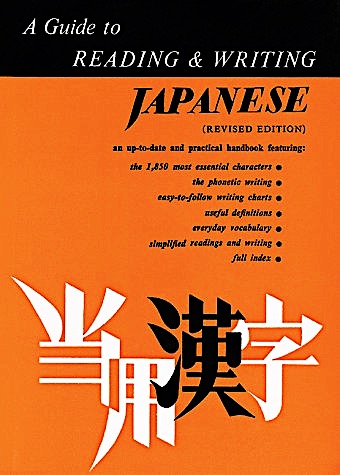
I learned the character 金 in my first kanji dictionary, A Guide to Reading & Writing Japanese by Tuttle publishing. It has a 1988 copyright date, which was the 61st printing (!) of the original 1959 publication. Does it look familiar to anyone?
金 is #16 of the 881 essential characters, which is based on standards established by the Japanese Ministry of Education.
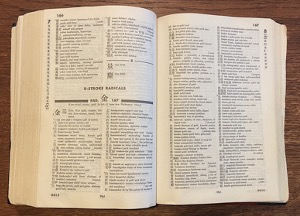
I also know gold 金 as radical #167, an 8-stroke radical for at least 21 characters (I counted) in my beloved and quite well-worn Nelson’s kanji dictionary (the edges are frayed edges from thumbing through it).
This dictionary has over 5,000 characters and almost 70,000 compounds! But to read a Japanese newspaper, you need to know roughly 2500 kanji.
I closely associate 金 with Friday, called 金曜日, kinyōbi in Japan. Japan adopted the gregorian calendar and a seven day planetary week (in lieu of the traditional lunar calendar) in 1873. Kinyōbi is a reference to Venus (金星, kinsei, or gold planet), but I memorized it by thinking it is a truly golden day of the week since it precedes time off! Clearly, the Japanese also identify time off as golden (I mean, who doesn’t??) as can be seen in the use of the term Golden Week, ゴールデンウイーク, a week of national holidays.
3 more 金 words
Three other word associations quickly come to mind:
1. 金魚 kingyō, or goldfish. The importance of goldfish to Japan should not be overshadowed by the more well-known Japanese 鯉 koi, or carp. (You can see my post on goldfish shortly.)
2. The Temple of the Golden Pavilion, 金閣寺 Kinkakuji is a gorgeous, must-see temple in Kyoto. Kinkakuji is also the title of a very famous 1956 novel by Yukio Mishima—a classic work by one of Japan’s most renowned authors. The book is well-read in Japan as well as by Japan Studies students around the world.
3. This kotowaza 諺 (a Japanese proverb): 金あればバカも旦那 has been translated to mean something like the English-language proverb “the money makes the man” (deliberately gendered once upon a time). But Kane areba baka mo danna has a little bit of a different emphasis and is closer to the idea that “even a fool is the master if he has money.” Note that this proverb uses all three writing systems!
In the end, getting the photo of 金 over my head was sort of random since we were actually trying for 日本, Nihon, or Japan. It proved too elusive. Yet capturing 金 instead has ended up being perfect—pure gold!—as the subject for my first blog post (which is a different kind of digital “art”??). Nonetheless, I’d have to say that teamLab Borderless’s digital art is striking gold in a real sense. If the line we had to wait in—even with advance purchase tickets, which I highly recommend or you may not get in—is any indication, they have the money but are no fools. My final thought on the benefit of capturing 金 is that I’m launching my blog today and it is, after all, 金曜日 (Friday)!
では またね! Thanks for reading!
 love・learn・Japan
Beautiful observations, beautifully written. Pure gold!!
LikeLike
This is so brilliant, interesting, and fun all at once!!!
I love it and cannot wait to learn more. The photo is particularly compelling!
LikeLike