
Last updated July 22, 2022
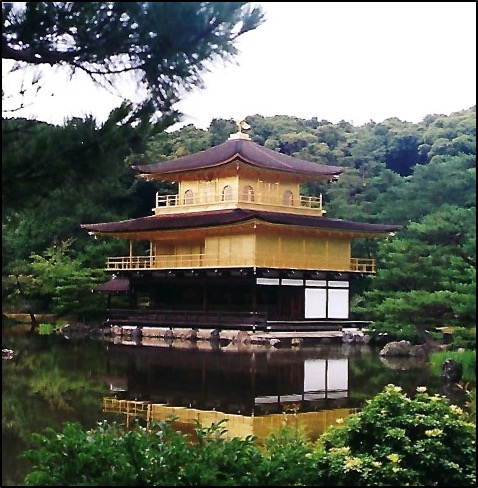
Kinkakuji 金閣寺, or the Temple of the Golden Pavilion, always appears on must-see lists for visitors to Kyoto. Is there really a good reason for this?? After all, the current pavilion of this Zen Buddhist Temple was only built in 1955 and its thick coat of gold leaf was applied in the late 1980s. Sure, it’s cool looking, but what is all the fuss about? Kinkakuji is often considered a cultural landmark, a symbol of Kyoto, and has even been designated a UNESCO world heritage site. WHY?
金 = gold
閣 = can be translated as pavilion but might also be used for a palace or government office. This character is also recognizable in reference to the government’s Cabinet 内閣 (Naikaku) and in the long title for Prime Minister, or Naikaku sōridaijin 内閣総理大臣寺 = temple; tera (kunyomi) or ji (onyomi); or by itself as otera. I introduced onyomi and kunyomi character (kanji) readings in my previous post.
The name Kinkakuji is made up of these characters: 金 (kin) + 閣 (kaku) + 寺 (ji)
I went back to the journal I kept as an exchange student to see what I wrote about Kinkakuji in the hopes that I could provide a pithy and insightful quote in this post. But I simply wrote in passing that I went there. This first visit would have been only one year after the gilding renovation was completed in 1987, which should have made it really shine. But would I have known that? Or cared? By contrast, I wrote a full page about spending time at its neighbor, the enigmatic stone garden, Ryōanji 龍安寺 (which is never called by its translated name of “The Temple of the Dragon at Peace”). Surprised and disappointed to find I said absolutely nothing about my impressions of Kinkakuji, I’m thinking now I’ll have to write a post about Ryōanji if I really want to quote my young (and apparently clueless) self.
The truth is that Kinkakuji 金閣寺 is a fabulous place to go! Three reasons explain its fame and popularity. It has:
- 1. an interesting history;
- 2. exceptional beauty that is at once traditional and unique; and
- 3. a serene setting (that is if you go in the early morning before it gets packed with foreign tourists and Japanese school groups).
1. Interesting history
For one thing, the temple’s history is old. Kinkakuji was first built in 1397. That was 622 years ago! As an American, I find Japan’s history thrilling since we do not have any historic landmarks that even come close to that age. Ashikaga Yoshimitsu, 足利義満 (1358-1408), a medieval (Muromachi-era) shogun and grand chancellor of state, built a great retirement complex that included Kinkakuji. None of the other buildings have survived and the golden pavilion has been reconstructed.
After Yoshimitsu moved to this country estate after he retired, he nonetheless continued to hold much power. He even hosted envoys from the Chinese and Korean courts at Kinkakuji. As you may guess from the splendor of Kinkakuji, he thought pretty highly of himself. The Ming court addressed him as “the King of Japan.” Of course, there was no king in Japan, only the emperor, but Yoshimitsu didn’t care. He later tried to give himself a title reserved for retired emperors but died before he could do so. He had managed, however, to arrange for the complex to become a Zen Buddhist temple upon his death.
Did you notice that I wrote Ashikaga Yoshimitsu with his family name first, which is standard Japanese style? And then did you notice that I called him by his given name, Yoshimitsu, in the next paragraph? The reason is that although one usually refers to someone by their family name, a person’s given name is often used when discussing historical figures or famous people.
Since then, Kinkakuji has burned down and been rebuilt a number of times. The last time was in 1950 when a Buddhist monk deliberately set it on fire. This incident prompted the famous Japanese novelist, Yukio Mishima (or in Japanese order putting the last name first, 三島由紀夫 Mishima Yukio), to write the acclaimed Temple of the Golden Pavilion. Have you read it?
2. serene setting
The Pavilion is located in the foothills of the northwestern edge of Kyoto in an area that was once outside the city. It was originally created to be a retirement villa. The changing of the seasons, shifts in weather, and the time of day can alter the feel of the place, often in dramatic ways. And, since it is situated on the edge of a large pond, Kinkakuji’s gold leaf exterior—together with the colors of surrounding flowers, leaves, and sky—are all the more striking because their images shine in the water.
The pond, quite aptly named Mirror Pond (鏡湖池 or Kyōkochi), is interesting in its own right. Dotted with ten small islands, each carefully placed and imbued with meaning, it is a spot for contemplation. Scroll back up to the image at the top of the page. Don’t you feel calm just looking at it?!
3. exceptional beauty
Certainly, the aesthetic appeal of the Temple of the Golden Pavilion is enhanced by its setting, but the vibrant gold leaf that covers the top two stories of the three-story Pavilion (built in three different architectural styles) is truly stunning. [Soon you can see my post on Japan’s traditional art of using gold leaf, or 金箔 kinpaku]. The temple was initially, and is still officially, called 鹿苑寺 Rokuonji (Deer Garden Temple), but the name Temple of the Golden Pavilion has prevailed.
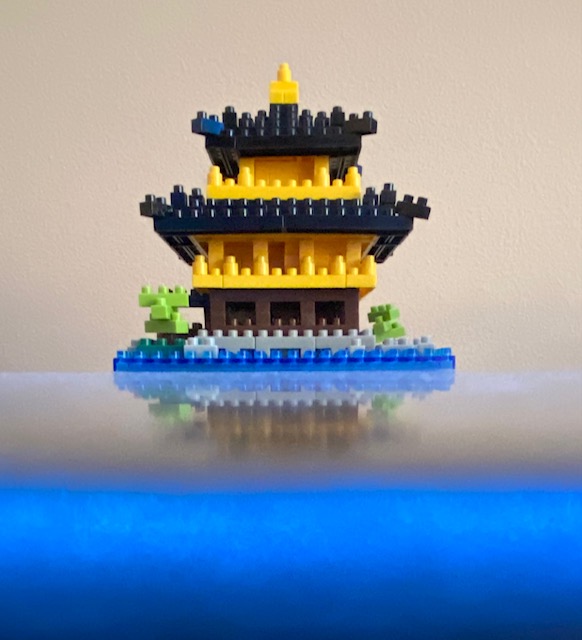
One way to consider the importance of the gold leaf exterior is to compare it to the Temple of the Silver Pavilion, or Ginkakuji 銀閣寺, located a good four and a half miles to the east. Kinkakuji was the inspiration for Ginkakuji, which was built by Yoshimitsu’s grandson, Ashikaga Yoshimasa.
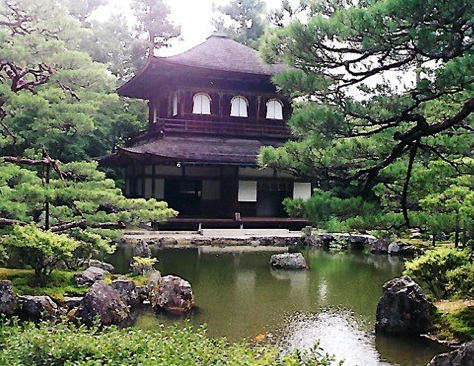
Yoshimasa originally named it the Temple of Shining Mercy, or Jishōji 慈照寺, but it, too, gained a more popular nickname. Ginkakuji was supposed to be covered in silver leaf but never was–so, unlike the Temple of the Golden Pavilion, the name matches the intent but not the result. I still think it has exceptional beauty.
In addition to the photos I’ve included in this post, each of these temples has a live camera with time-stamped photos that are purportedly taken every 3 minutes (san bun goto ni; 3分ごとに). I can’t vouch for the interval and the two aren’t quite in sync, but the images do change. Definitely check them out!
Ginkakuji http://www.shokoku-ji.jp/g_live.html
Kinkakuji http://www.shokoku-ji.jp/k_live.htm
Thinking of these two sister temples together immediately brings to mind a set of twins, Kin-san (gold) and Gin-san (silver) who gained wild popularity in the 1990s after they both reached their 99th birthdays (they lived to be 107 and 108).
Which temple do you like better—Kinkakuji or Ginkakuji? Why? Does the gold leaf win out? Can you imagine the other covered in silver? Finally, do these temples rank among your must-see places in Kyoto?
More Kinkakuji items and references from my stash of Japan souvenirs
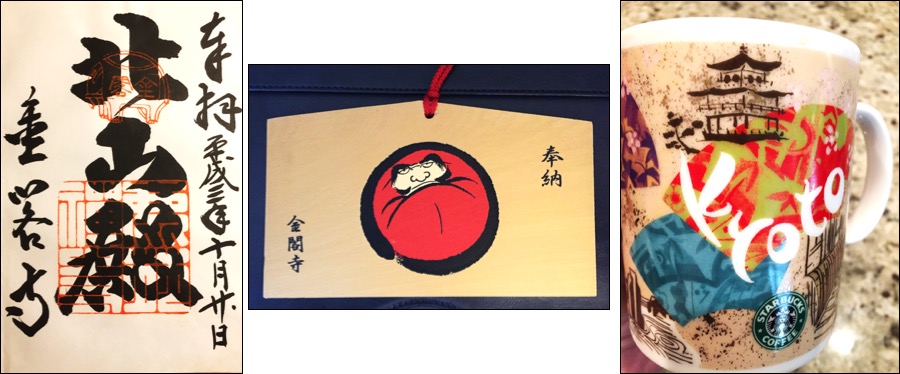
Temple calligraphy (shodō 書道) in my commemorative stamp book (goshūinchō 御集印帳), a votive picture (ema 絵馬), and a Kyoto Starbucks mug (see the mini Kinkakuji image at the top?)
では またね! Thanks for reading!
 love・learn・Japan